How to Select the Right Flat Belt Material for Textile, Printing, and Woodworking Machinery Where Slip and Surface Finish Matter
Flat belt selection is one of those decisions that gets made once and then revisited only when something goes wrong. The belt that shipped with the machine gets replaced with whatever the local supplier has available, and if it runs without obvious problems, the choice is considered adequate. The trouble is that “no obvious problems” and “optimal performance” are often different things, and in machines where the belt interacts directly with production outcomes — surface quality, material handling precision, tension consistency — the gap between adequate and right can show up in ways that aren’t immediately traced back to the belt.
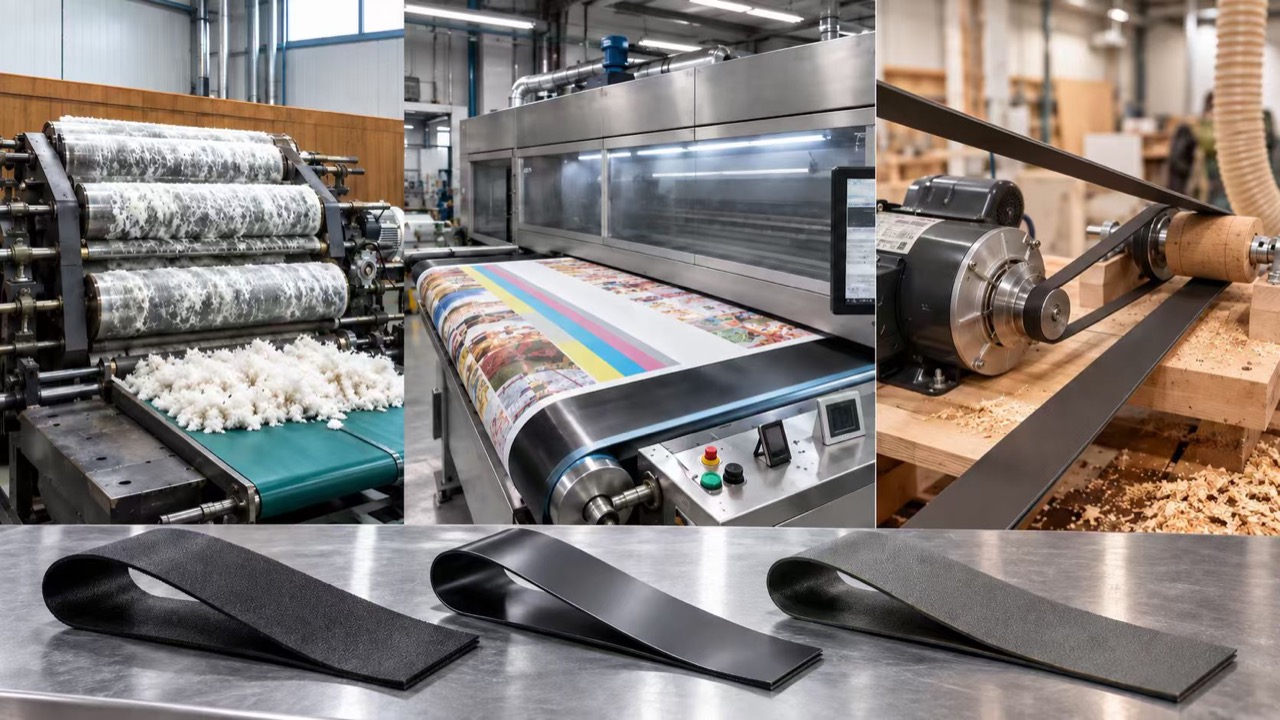
Textile, printing, and woodworking machinery share a characteristic that makes flat belt material selection particularly consequential: in each of these applications, the belt is often doing work that directly affects the finished product, not just transmitting power between two shafts in isolation from the output. Getting the material wrong produces problems that look like machine problems or operator problems before someone identifies the belt as the root cause.
Textile Machinery: Slip as a Feature, Then as a Problem
In spinning and winding applications, a certain amount of controlled slip between the flat belt and the driven roller is intentional. The slip absorbs tension variation, allows the driven element to respond to load changes without shock loading, and enables the speed differential that some twisting processes require. This is why flat belts have persisted in textile machinery long after synchronous drives became dominant in other industries — the slip characteristic is useful, not a deficiency.
The material choice determines where the slip happens and how consistently it behaves. Leather belts, which dominated textile drives for most of the twentieth century, have a friction coefficient that changes significantly with humidity and temperature. A leather belt running in a humid spinning room behaves differently in winter than in summer, and differently at shift start than after hours of running. Modern synthetic materials — polyamide, polyurethane, and layered composites — provide more consistent friction coefficients across a wider range of conditions, which makes machine behavior more predictable and reduces the tuning adjustments that experienced operators make instinctively with older belt materials.
The back face of the belt matters separately from the friction face. In applications where the belt runs against tension rollers or guides, a back face that generates consistent friction on steel or aluminum surfaces keeps the belt tracking predictably. A back face with inconsistent surface properties causes tracking variation that appears as vibration or uneven tension in the driven system — problems that are diagnosed at the machine level before anyone looks at the belt.
Printing Machinery: Surface Transfer and Contamination
Flat belts in printing machinery face a different set of concerns. The belt may run in close proximity to ink systems, dampening systems, or substrate transport mechanisms where any contamination transferred by the belt affects print quality. Belt material that off-gasses, sheds particles, or absorbs and then releases ink or solvent compounds creates contamination pathways that are difficult to trace.
Polyurethane belts are common in printing applications because polyurethane is dimensionally stable, resistant to most printing solvents, and produces a consistent surface that doesn’t transfer material to adjacent components. The hardness of the polyurethane — which varies by formulation — affects how the belt behaves on small-diameter pulleys and how it responds to tension variation. Softer formulations wrap smaller pulleys better; harder formulations maintain dimensional consistency better under load and temperature variation.
For substrate transport applications — where the belt is moving paper, film, or board rather than driving a mechanical component — the surface friction coefficient between the belt and the substrate matters more than the power transmission characteristics. A belt that slips against the substrate produces registration errors; a belt with too much grip produces marking on sensitive surfaces. Some printing applications require anti-static belt materials to prevent electrostatic discharge that would affect substrate behavior or attract dust.
The splice or joint in a flat belt running at printing speeds deserves attention that it doesn’t always receive. A mechanical splice introduces a thickness variation that creates a periodic disturbance in the driven system at a frequency determined by belt speed and circumference. At printing speeds, this can show up as a banding pattern in output at a frequency that doesn’t correspond to any obvious machine component — until someone measures the belt circumference and calculates the frequency.
Woodworking Machinery: Heat, Sawdust, and Grip
Flat belts in woodworking machinery deal with an abrasive environment that textile and printing applications don’t share. Fine sawdust is pervasive, and it behaves differently depending on the belt material. On some surfaces, sawdust acts as a lubricant, reducing friction and causing slip under load. On others, it packs into the belt surface over time and changes the friction behavior incrementally. On rough or textured belt surfaces, it accumulates and eventually affects belt tracking.
Smooth polyurethane or leather surfaces in dusty environments tend to have more consistent slip behavior than textured surfaces because dust doesn’t pack into a smooth surface the same way. The trade-off is that a smooth surface in a dusty environment is functioning with less friction than the same surface in a clean environment, so the belt has to be tensioned appropriately for the contaminated condition rather than the clean condition.
Heat is the other woodworking-specific concern. High-speed sawing and machining operations generate significant heat, and flat belts in enclosed drive compartments can run at elevated temperatures. Rubber-based belt materials soften and lose dimensional stability at temperatures that polyurethane or polyamide materials handle without issue. For high-duty-cycle woodworking applications where the machine runs continuously, the temperature range the belt will actually experience is worth checking against the material specification.
Making the Selection Systematic
The practical approach to flat belt material selection is to identify which of these concerns apply to the specific application before defaulting to whatever material is most available. Textile applications where controlled slip is part of the drive function need a material with a well-characterized and consistent friction coefficient. Printing applications where contamination matters need a material with appropriate chemical resistance and surface properties for the specific inks and solvents in use. Woodworking applications need a material that handles sawdust and heat without significant degradation in friction behavior or dimensional stability.
For machines where belt slip or surface behavior is affecting production outcomes and the cause hasn’t been identified, checking whether the current belt material is actually appropriate for the application is a faster diagnostic step than it might seem. A belt that’s adequate for transmitting power but not matched to the surface and slip requirements of the application will produce subtle, persistent problems that don’t respond to tension adjustment, pulley alignment, or the other interventions that usually address drive issues.
Sourcing Flat Belts with material specifications matched to the application — rather than selecting on availability or price — reduces the iteration that happens when a belt runs but doesn’t run right.